
Filing ITR Below Basic Exemption Limit – Complete Guide for Indian Taxpayers
Many taxpayers in India believe that if their income is below the basic exemption limit, they are not required to file an Income Tax Return (ITR). While this is true in most ordinary cases, the Income Tax Act contains several important exceptions where filing ITR becomes mandatory even if income is zero or below the exemption limit.
This article explains when you must file ITR despite low income, who is covered, and what happens if you ignore this requirement.
Table of Contents
What Is the Basic Exemption Limit?
The Basic Exemption Limit is the minimum income level up to which no Income Tax Return is required to be filed under normal circumstances.
Under the Old Tax Regime, the exemption limits are:
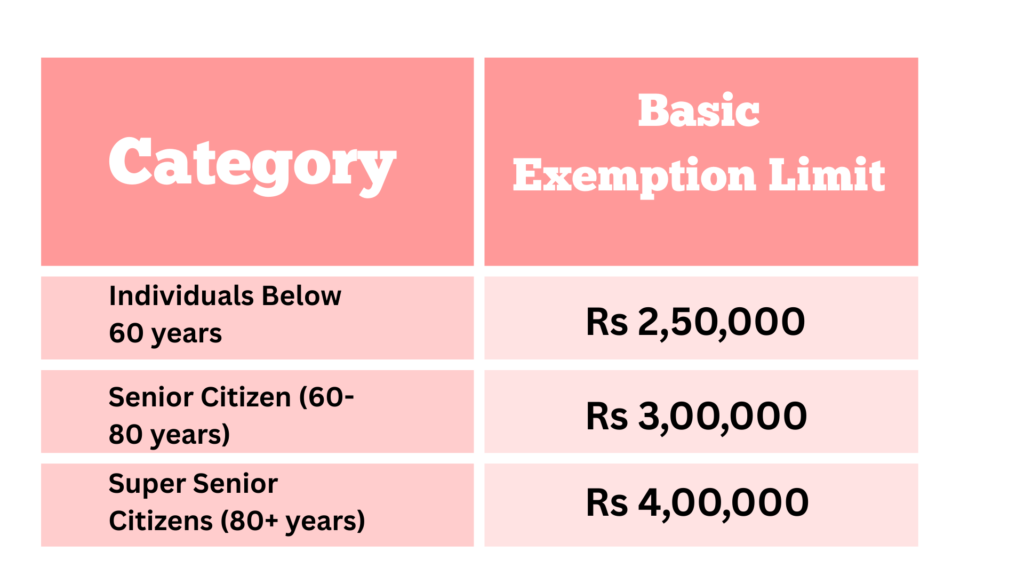
If your total income is below these limits, you normally do not have to pay income tax or file ITR.
However, Section 139(1) of the Income Tax Act overrides this exemption in many cases.
Why Does Income Tax Department Ask Low-Income People to File ITR?
The government monitors financial behaviour, not just income.
High-value transactions, foreign assets, luxury expenses, or business activity may exist even when taxable income is low.
Therefore, ITR filing becomes a compliance requirement to prevent tax evasion and track money movement.
Cases Where Filing ITR Is Mandatory Even If Income Is Below Exemption Limit
Let us understand each legally prescribed situation.
1. Companies and Firms Must File ITR Even With Loss
Every company and partnership firm must file ITR — even if they have no income or suffered a loss.
Example:
Shale Ltd incurred a loss of ₹25 lakhs in FY 2025–26.
Still, it must file ITR for AY 2026–27.
This applies to:
- Private Limited Companies
- LLPs
- Partnership Firms
- One Person Companies
Failure to file attracts heavy penalties.
2. Foreign Assets or Foreign Income
If you:
- Own property abroad
- Have a foreign bank account
- Hold shares or investments outside India
- Earn foreign rental or interest income
You must file ITR, even if total income is very low.
Example:
Mr. Raman owns a flat in London and earns ₹20,000 per month rent.
Though his Indian income is below ₹2.5 lakh, he must file ITR because he holds a foreign asset.
This rule applies even if the income is not taxable in India.
3. Deposits of ₹1 Crore or More in Current Accounts
If the total deposits in all your current accounts exceed ₹1 crore in a financial year, ITR filing becomes compulsory.
Example:
Mr. Bhushan deposited ₹21 lakh each in five current accounts (₹1.05 crore total).
His income is only ₹2 lakh — but he must file ITR.
This rule targets high-volume money movement.
4. Spending More Than ₹2 Lakh on Foreign Travel
If you spend more than ₹2 lakh on foreign travel, whether for yourself or someone else, ITR filing is mandatory.
Example:
Mr. Siddhant earned ₹2 lakh in a year but spent ₹2.5 lakh on a Bali trip.
He must file ITR for AY 2026–27.
5. Electricity Bill Above ₹1 Lakh
If your annual electricity bill exceeds ₹1 lakh, you must file ITR even if your income is low.
Example:
Miss Samridhi paid ₹1.5 lakh in electricity charges during FY 2025–26.
She is required to file ITR.
This indicates high lifestyle spending.
6. High Turnover or Business Receipts
You must file ITR if:
- Business sales ≥ ₹60 lakh, or
- Professional receipts ≥ ₹10 lakh
even if profit is low or zero.
This applies to:
- Traders
- Consultants
- Freelancers
- Shop owners
7. High TDS or TCS
If the aggregate TDS or TCS is more than ₹25,000, ITR filing is compulsory (₹50,000 for senior citizens).
This often happens when:
- Fixed deposits
- Commission
- Rent
- Bank interest
are involved.
8. Savings Bank Deposits of ₹50 Lakh or More
If total deposits in all savings accounts exceed ₹50 lakh in a year, ITR must be filed regardless of income.
Conclusion
Many people wrongly believe that low income means no ITR filing. In reality, India’s Income Tax Law focuses on financial behaviour, not just salary.
If you have:
- Foreign assets
- High deposits
- Luxury expenses
- Business turnover
- High TDS
- Expensive electricity or travel
then ITR filing is compulsory — even if your income is zero.
Understanding these rules protects you from penalties and keeps your financial life clean and transparent.
If you need help with ITR filing, compliance, or tax planning, feel free to contact Uniserve Business Solution for professional guidance.